Outputs
Get all device outputs
Returns all available outputs and their (logical) state. See SupportedDevices to learn more about what outputs are available.
URL parameters
hostIp: ip address of the API host.
deviceId: id of the device.
- GET https://{hostIp}:7081/hal/devices/{deviceId}/outputs
Example request:
GET /hal/devices/io1/outputs HTTP/1.1
Accept: application/json
Authorization: Bearer eyJhbGciOiJS...
Example response:
HTTP/1.1 200 OK
Content-Type: application/json; charset=utf-8

[
  {
      "value": 0,
      "name": "OUTD1"
  },

  ...

  {
      "value": 1,
      "name": "OUTDX"
  }
]
- Status Codes:
200 OK – OK
400 Bad Request – Bad Request. A descriptive error comes along with this error.
401 Unauthorized – Unauthorized. Something is wrong with the Authorization header of the request
403 Forbidden – Forbidden. Something is wrong with the claims of the user.
500 Internal Server Error – Internal Server Error
- Response Headers:
Content-Type – defines the serialization format for the response body (this depends on the Accept header of the request)
- Response JSON Object:
outputs (array) – array with outputs and their logical values (0 or 1)
Get one or more outputs
Returns all desired outputs and their (logical) state.
URL parameters
hostIp: ip address of the API host.
deviceId: id of the device.
outputName1 / outputName2: See SupportedDevices to learn more about what outputs are available.
- GET https://{hostIp}:7081/hal/devices/{deviceId}/outputs?outputName={outputName1}&outputName={outputName2}
Example request:
GET /hal/devices/io1/outputs?outputName=OUTD1&outputName=OUTD2 HTTP/1.1
Accept: application/json
Authorization: Bearer eyJhbGciOiJS...
Example response:
HTTP/1.1 200 OK
Content-Type: application/json; charset=utf-8

[
  {
      "value": 0,
      "name": "OUTD1"
  },
  {
      "value": 1,
      "name": "OUTD2"
  }
]
- Status Codes:
200 OK – OK
400 Bad Request – Bad Request. A descriptive error comes along with this error.
401 Unauthorized – Unauthorized. Something is wrong with the Authorization header of the request
403 Forbidden – Forbidden. Something is wrong with the claims of the user.
500 Internal Server Error – Internal Server Error
- Response Headers:
Content-Type – defines the serialization format for the response body (this depends on the Accept header of the request)
- Response JSON Object:
outputs (array) – array with outputs and their logical values (0 or 1)
Set one or more outputs
Sets outputs to a desired (logical) state.
URL parameters
hostIp: ip address of the API host.
deviceId: id of the device.
URL body
Array with outputs, each with their desired action and logical value(s). To be able to support all action types on a specific output, the following generic parameters are used for each output:
state (integer) : possible values : 1,2,3 or 4
1 : Set / Set Pulse : persistent set to a value or set to a value for a certain time
2 : Reset : persistent set to value 0
3 : Toggle: persistent set to previous value
4 : Interval: repetitively set to either value1 or value2 for a certain time
value1 (integer) : 0 or >0 (always 1 for digital output)
time1 (integer) : time in ms. Value may be 0 or >100 [100,65635]
value2 (integer) : 0 or >0 (always 1 for digital output)
time2 (integer) : time in ms. Value may be 0 or >100 [100,65635]
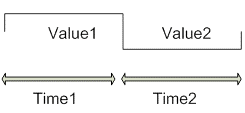
The table below specifies the values for Value1, Time1, Value2, Time2 related to the State property
State |
Value1 |
Time1 |
Value2 |
Time2 |
Result |
Reset |
x |
x |
x |
x |
Persistent set to value 0 |
Toggle |
x |
x |
x |
x |
Persistent set to previous value |
Set |
>0 |
0 |
0 |
0 |
Set persistently to Value1 |
Set |
>0 |
1000 |
0 |
0 |
Set to Value1 for 1000ms, then persistent set to value 0 (Set Pulse) |
Set |
0 |
0 |
>0 |
>0 |
Not supported |
Interval |
>0 |
1000 |
>0 |
1000 |
Set to Value1 for 1 second, then set to Value2 for 1 second and repeat this endlessly. |
- POST https://{hostIp}:7081/hal/devices/{deviceId}/outputs
Example request:
POST /hal/devices/io1/outputs HTTP/1.1
Accept: application/json
Authorization: Bearer eyJhbGciOiJS...

[
  {
      "name": "OUTD1",
      "state" : 1,
      "value1" : 1,
      "time1" : 0,
      "value2" : 0,
      "time2" : 0
  },

  ...

  {
      "name": "OUTDX",
      "state" : 1,
      "value1" : 1,
      "time1" : 1000,
      "value2" : 0
      "time2" : 0
  }
]
Example response:
HTTP/1.1 200 OK
Content-Type: application/json; charset=utf-8
- Status Codes:
200 OK – OK
400 Bad Request – Bad Request. A descriptive error comes along with this error.
401 Unauthorized – Unauthorized. Something is wrong with the Authorization header of the request
403 Forbidden – Forbidden. Something is wrong with the claims of the user.
500 Internal Server Error – Internal Server Error
- Response Headers:
Content-Type – defines the serialization format for the response body (this depends on the Accept header of the request)